Document Processing and OCR Correction
Human review and correction of OCR output for documents, forms, invoices, and historical records across 250+ scripts and languages.
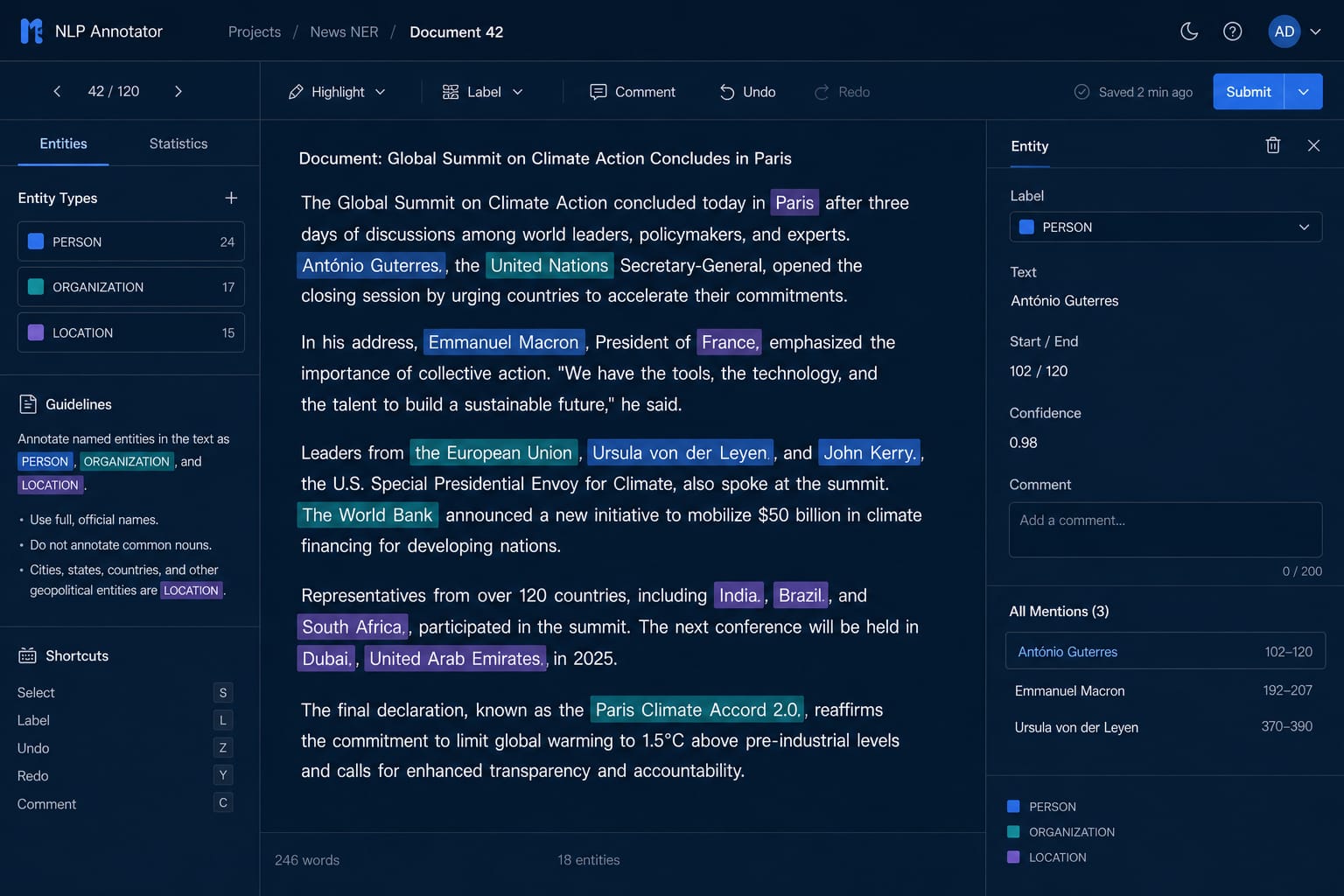
OCR (optical character recognition) engines produce imperfect text from document images, particularly for handwritten content, degraded historical documents, non-Latin scripts, and complex document layouts. Human correction of OCR output produces the accurate ground truth needed to train document AI models, benchmark OCR system performance, and build production document processing pipelines.
Corpshore delivers OCR correction and document processing across 250+ languages and scripts, including Arabic, Cyrillic, Devanagari, CJK, Thai, Georgian, and others where commercial OCR tools underperform. Annotators trained in the target script review OCR text against document images, correct character and word errors, and tag structural elements such as headers, tables, and form fields.
Common use cases
- Invoice and receipt processing: accurate extraction of amounts, dates, and line items
- Historical document digitization: ground truth for archive OCR programs
- Legal and medical document processing: form field extraction and content verification
- Multilingual document AI: training models for non-Latin script document understanding
- Form recognition: layout and field label annotation for structured document models
Industries served
Delivery details
Delivered as corrected text files, structured JSON with field labels and bounding boxes, or annotated page images depending on the downstream document AI pipeline. Script-specific annotators are assigned for every non-Latin script in the program.
Frequently asked questions
Corpshore covers 250+ languages, including all major scripts: Latin, Arabic (and Arabic-script languages including Urdu, Persian, Pashto), Cyrillic (Russian, Ukrainian, Bulgarian, Serbian), Devanagari and related South Asian scripts, CJK (Chinese, Japanese, Korean), Thai, Georgian, Armenian, Hebrew, and others. Script-specific annotators are assigned from the nearest in-region hub for each language.
Learn the terminology
Full service scope
Ready to scope a pilot?
Tell us your modality, volume, and languages. We'll return an indicative scope, timeline, and cost band.