Annotation & Labeling
Corpshore AI provides multimodal annotation and labeling, image, video, LiDAR, text, audio, and multimodal, delivered with 97%+ accuracy through a three-tier QA cascade.
Scoped, staffed, and QA-gated
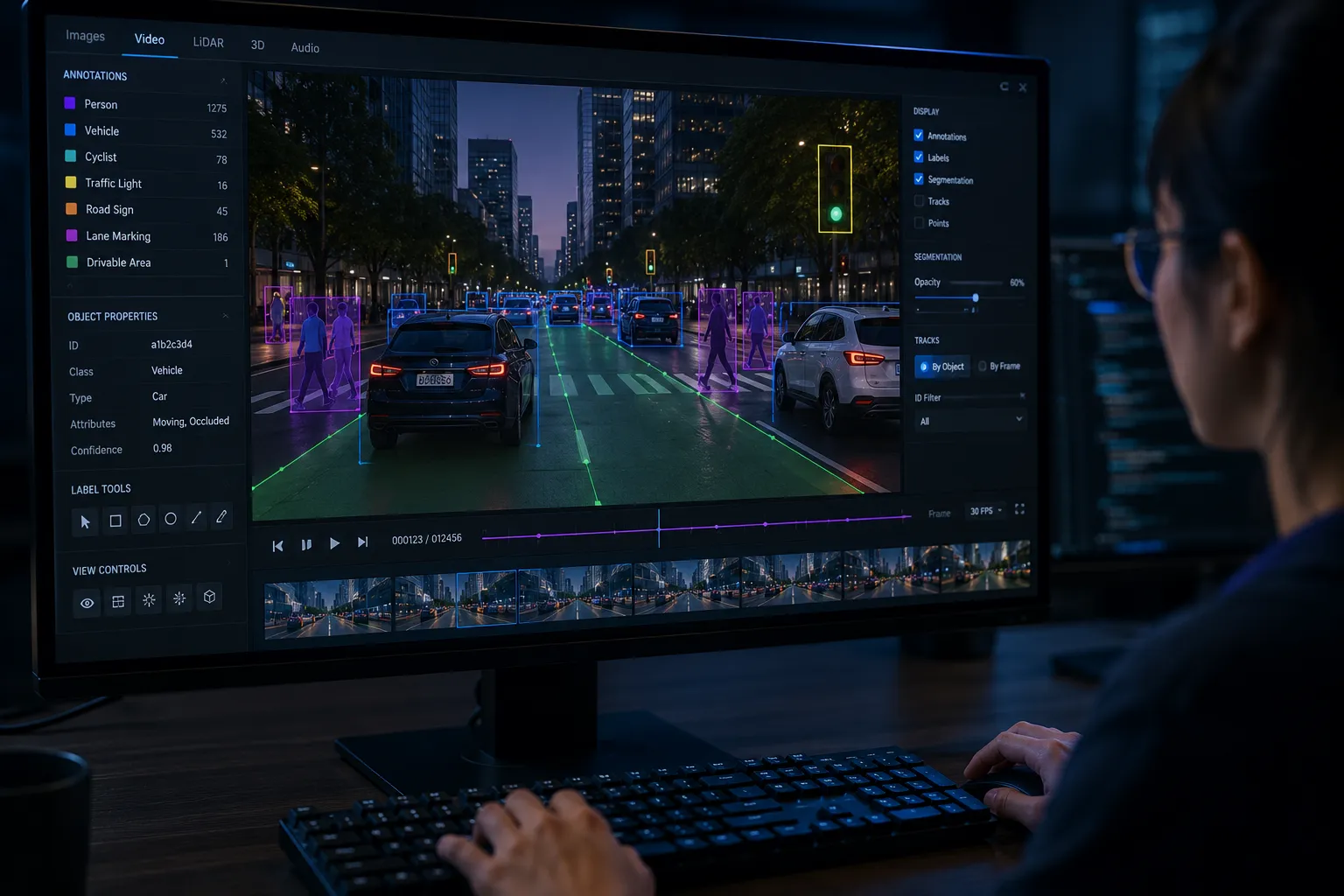
- 2D/3D bounding boxes, polygons, and segmentation
- Video object tracking and event labeling
- LiDAR / point-cloud cuboids and semantic segmentation
- Text NER, classification, and relationship labeling
The problems this service addresses
Where teams use this work
Illustrative examples of how this service fits real programs. They are representative use cases, not named clients.
An autonomous-driving perception team
The team needs dense 3D cuboids and semantic segmentation on LiDAR and camera frames, labeled to one convention across sequences, so perception regressions stop tracing back to inconsistent labeling.
A medical-imaging company in a regulated pathway
A team needs clinician-grade image labels with documented reviewer credentials and a chain of custody per label, so the dataset is defensible in a regulatory submission.
A content-moderation platform
A trust-and-safety team needs high-volume multimodal classification against a detailed policy taxonomy, held consistent as the taxonomy evolves, so enforcement decisions stay aligned across reviewers.
A retail search team
A team needs product images labeled with attributes and relationships across a large catalog, with a taxonomy tight enough that agreement stays high as new categories are added.
From scope to delivery, end to end
Step through the stages of a annotation & labeling engagement.
1. Align taxonomy and schema
Map your label definitions, edge cases, and export format, and validate the taxonomy against a real sample so it is unambiguous before volume begins.
A live look at the work
Switch tabs to see how a labeling, preference, or transcription unit moves through the QA cascade.
How the engagement runs
- It starts with your taxonomy, label schema, and a real data sample, which a pilot uses to establish the realistic accuracy for your specific edge cases.
- Ambiguous or difficult label schemas are tightened during the pilot, so the production run starts from a proven rubric.
- A dedicated pod is staffed rather than rotating crowd workers, so the same trained team carries your edge cases forward across batches.
- Work runs in your annotation platform or in Corpshore's, matching your export format so labels flow straight into your pipeline.
- Every unit passes the three-tier QA cascade, and inter-annotator agreement is tracked and reported rather than assumed.
- You provide the taxonomy, sample data, and acceptance thresholds; Corpshore provides the pod, tooling fit, QA, and delivery cadence.
What doing this well requires
- Label consistency, not raw accuracy on any single unit, is what perception and classification models actually depend on.
- A well-designed taxonomy is the single biggest driver of inter-annotator agreement, so ambiguity is cheaper to fix in the schema than in review.
- Dedicated pods beat marketplace bidding on hard programs because retained annotators accumulate edge-case knowledge that crowd work discards.
- Agreement should be measured and reported per batch; a number you can see is what turns quality from a claim into a gate.
- Expert domains need provenance captured per label from the start, because a chain of custody cannot be reconstructed convincingly after delivery.
Every unit passes a three-tier QA cascade
Annotator + peer review
Trained in-region annotators label to a versioned taxonomy. Every unit gets a structured peer check before it moves.
Expert QA lead
Domain QA leads audit sampled and flagged work, resolve edge cases, and feed corrections back into annotator guidance.
Programmatic + consensus
Automated consistency checks, gold-set benchmarking, and consensus scoring gate the batch before delivery.
Annotation & Labeling, answered
Image, video, LiDAR and 3D point cloud, text, audio, and multimodal, all delivered at 97%+ accuracy through the three-tier QA cascade. Within those, Corpshore handles bounding boxes, polygons, semantic and instance segmentation, keypoints, object tracking, cuboids, NER, classification, and relationship labeling.
Ready to scope a pilot?
Tell us your modality, volume, and languages. We'll return an indicative scope, timeline, and cost band.