Named Entity Recognition (NER)
Entity span annotation for people, organizations, locations, dates, products, and domain-specific entities across 250+ languages.
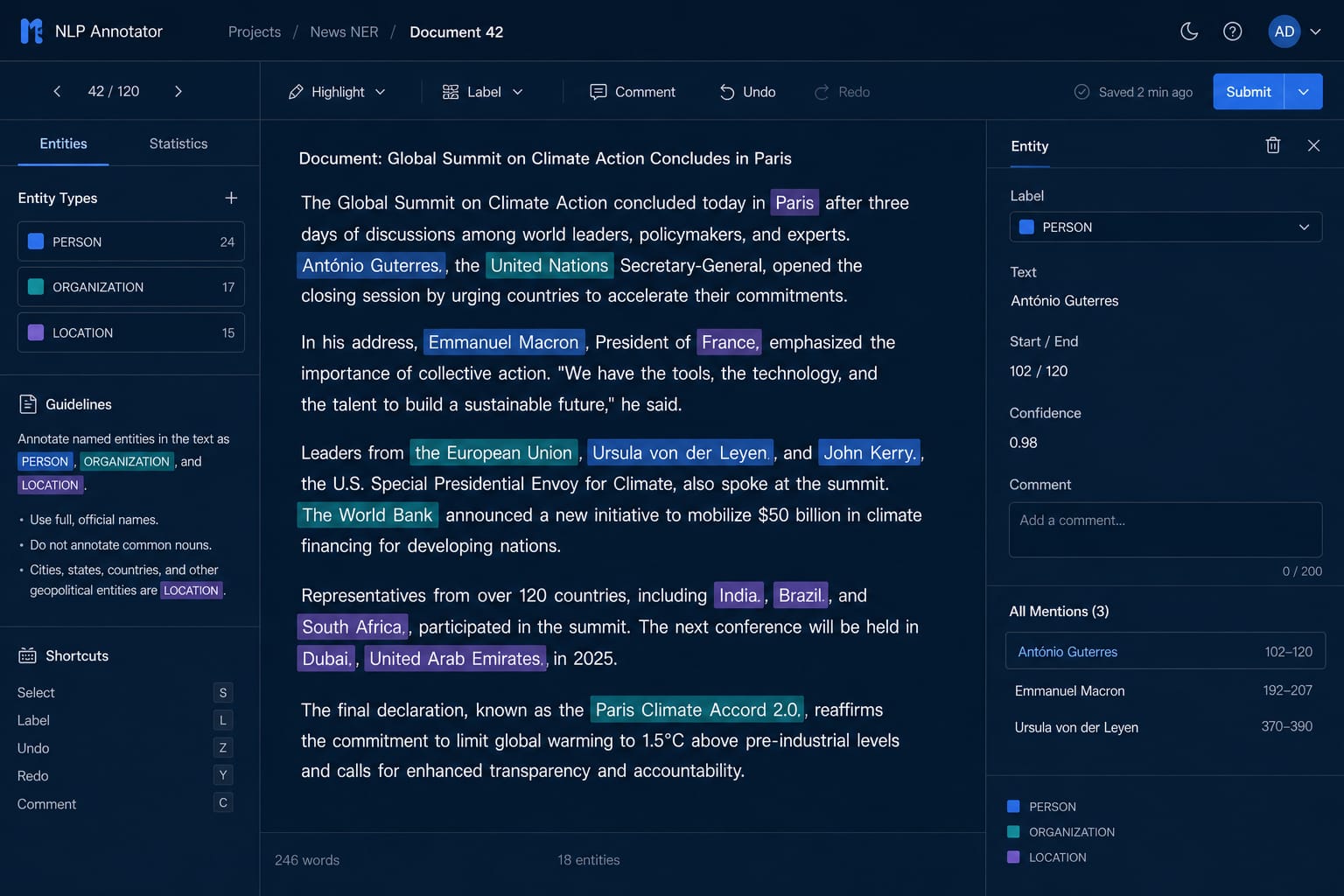
NER annotation marks spans of words in text as named entities and assigns them to predefined types. Standard schemas label PERSON, ORGANIZATION, LOCATION, DATE, TIME, and PRODUCT. Domain-specific schemas add types for the application: DRUG, DOSAGE, and CONDITION in medical NER; CLAUSE, PARTY, and OBLIGATION in legal NER; TICKER, COMPANY, and EVENT in financial NER.
Corpshore produces NER datasets in 250+ languages with native-speaker annotators in every language. Multilingual NER requires genuine linguistic expertise rather than translation: entity boundaries and types differ across languages, and idiomatic expressions, honorifics, and name conventions differ significantly from English-centric patterns. Corpshore's native annotator network is the primary mechanism for delivering accurate NER across rare and low-resource languages.
Common use cases
- Information extraction: identifying people, organizations, and events in news and documents
- Contract analysis: extracting parties, obligations, dates, and jurisdiction from legal text
- Medical record processing: identifying diagnoses, medications, and procedures in clinical notes
- Financial intelligence: extracting company events, officers, and financial figures from filings
- Customer service: routing queries by entity type and account references
- Multilingual search and retrieval: entity-aware indexing across language collections
Industries served
Delivery details
Delivered in IOB2/BIOES tagging format, standoff JSON, or inline span JSON depending on the downstream NLP framework. Each span includes start and end character offsets, the entity type, and optional confidence or annotator notes.
Frequently asked questions
Annotation guidelines are written or reviewed by native speakers in each target language to reflect the entity conventions of that language. Where entity types behave differently across languages, language-specific addenda to the main guidelines document the differences with worked examples. Native annotators are paired with QA reviewers who are also native speakers to catch cross-language guideline misinterpretations.
Learn the terminology
Full service scope
Ready to scope a pilot?
Tell us your modality, volume, and languages. We'll return an indicative scope, timeline, and cost band.