Semantic Segmentation
Pixel-level scene understanding annotation for autonomous systems, medical imaging, and satellite analysis.
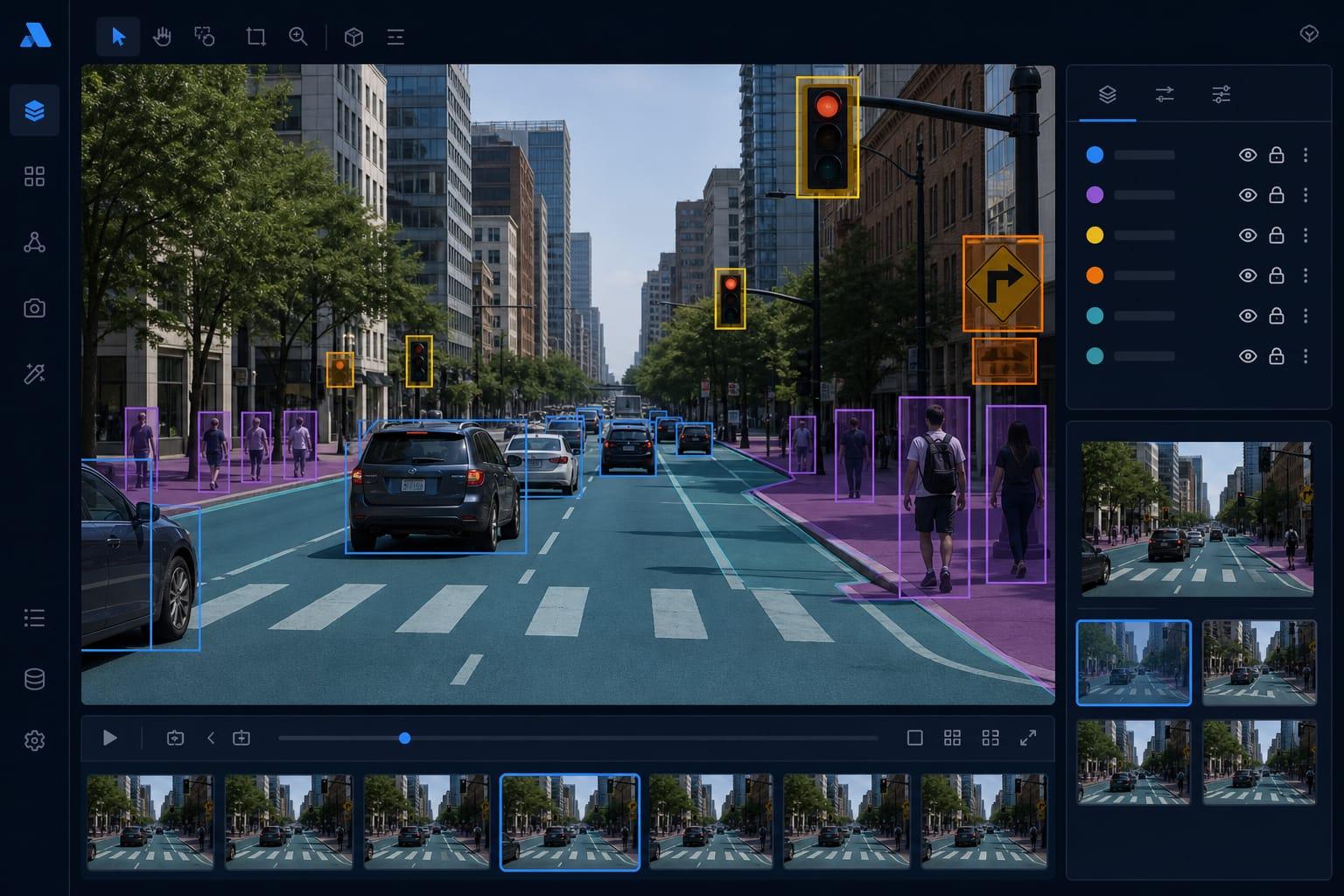
Semantic segmentation assigns a class label to every pixel in an image, producing a dense classification map that covers the entire scene. Unlike bounding box annotation, which locates objects with rectangles, semantic segmentation provides a precise understanding of what occupies each part of the image. This is essential for autonomous driving systems that must distinguish drivable road surface from sidewalk, vegetation, and parked vehicles at pixel resolution.
Corpshore produces semantic segmentation labels for outdoor scenes, indoor environments, medical images, aerial and satellite imagery, and industrial contexts. Annotators trained on specialist tools handle complex edge cases including occlusions between adjacent objects, fine-structure objects such as poles and fences, and sky and ground regions with ambiguous boundaries.
Semantic segmentation is among the most labor-intensive annotation types because every pixel requires a label decision. Corpshore programs use polygon-to-mask workflows to accelerate production while maintaining edge accuracy, with human review of boundary regions as a final QA step before delivery.
Common use cases
- Autonomous driving: full scene understanding for path planning
- Medical imaging: organ, lesion, and tissue segmentation
- Satellite and aerial imagery: land use and infrastructure mapping
- Augmented reality: foreground and background scene separation
- Agricultural analysis: crop type and health mapping
- Industrial inspection: surface area defect classification
Industries served
Delivery details
Semantic segmentation is delivered as class-indexed PNG masks or COCO JSON with polygon annotations convertible to raster. Class taxonomy and pixel-level handling rules for class boundaries are defined during scoping.
Frequently asked questions
Semantic segmentation classifies every pixel as belonging to a class but treats all instances of that class as one region. Instance segmentation additionally assigns a unique identity to each individual object, so two adjacent cars are labeled as two separate instances rather than one merged car region. If your model needs to count or track individual objects, instance segmentation is the appropriate task.
Learn the terminology
Full service scope
Ready to scope a pilot?
Tell us your modality, volume, and languages. We'll return an indicative scope, timeline, and cost band.