Sentiment and Emotion Annotation
Polarity, aspect-level sentiment, and emotion category annotation for training models that understand human affective expression.
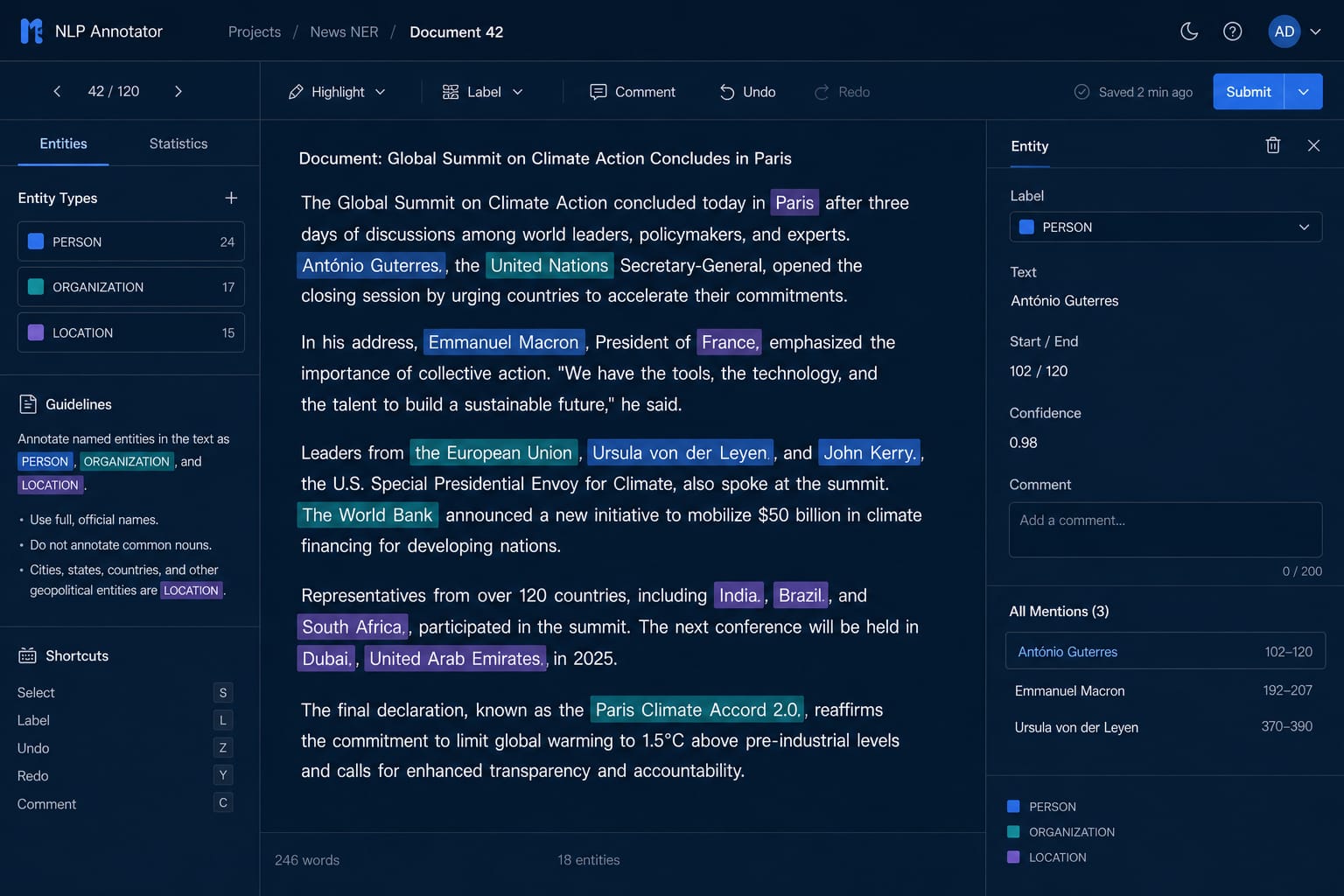
Sentiment annotation assigns polarity labels (positive, neutral, negative) to text items. Aspect-based sentiment annotation extends this to individual entities or topics mentioned in the text, labeling the sentiment associated with each aspect independently. Emotion annotation uses a richer schema, labeling specific emotional states such as joy, anger, sadness, surprise, disgust, fear, and neutral.
Sentiment and emotion are culturally influenced: irony, sarcasm, and indirect expression vary significantly across languages and regional cultures. Corpshore's native annotator network is essential for multilingual sentiment programs because cross-cultural annotation using a single annotator community introduces systematic labeling biases that reflect the annotators' culture rather than the target community's expression patterns.
Common use cases
- Customer feedback analysis: routing and prioritizing support interactions by sentiment
- Brand monitoring: tracking sentiment across markets and languages in social media
- Financial news sentiment: scoring news articles for trading signal generation
- Healthcare support: detecting distress signals in patient communications
- Content moderation: detecting hostile or inflammatory emotion in user content
- Product review analysis: aspect-level sentiment for product improvement insights
Industries served
Delivery details
Delivered as JSONL or CSV with item ID, text, polarity, and optional aspect and emotion fields. Annotation guidelines define the taxonomy and worked examples for borderline cases. Inter-annotator agreement measurement is included as a standard quality report.
Frequently asked questions
Annotation guidelines include explicit rules for sarcasm and irony, typically requiring annotators to label the intended sentiment rather than the literal surface meaning, with support from context signals in the surrounding conversation. Items that require contextual interpretation are flagged for peer review to reduce individual annotator judgment errors.
Learn the terminology
Full service scope
Ready to scope a pilot?
Tell us your modality, volume, and languages. We'll return an indicative scope, timeline, and cost band.