AI training data for Foundation models
RLHF, preference data, SFT demonstrations, and red-teaming for LLM alignment: multilingual, high-agreement, at a plannable cadence.
Data operations tuned to Foundation models
Frontier models need alignment data at a steady cadence across many languages. Corpshore AI produces ranked comparisons, preference pairs, SFT demonstrations, and reward-model data with native, in-region annotators in 35+ languages, then red-teams the model against real-world and policy risks. Employed teams under one SLA give you a plannable pipeline rather than a variable crowd.
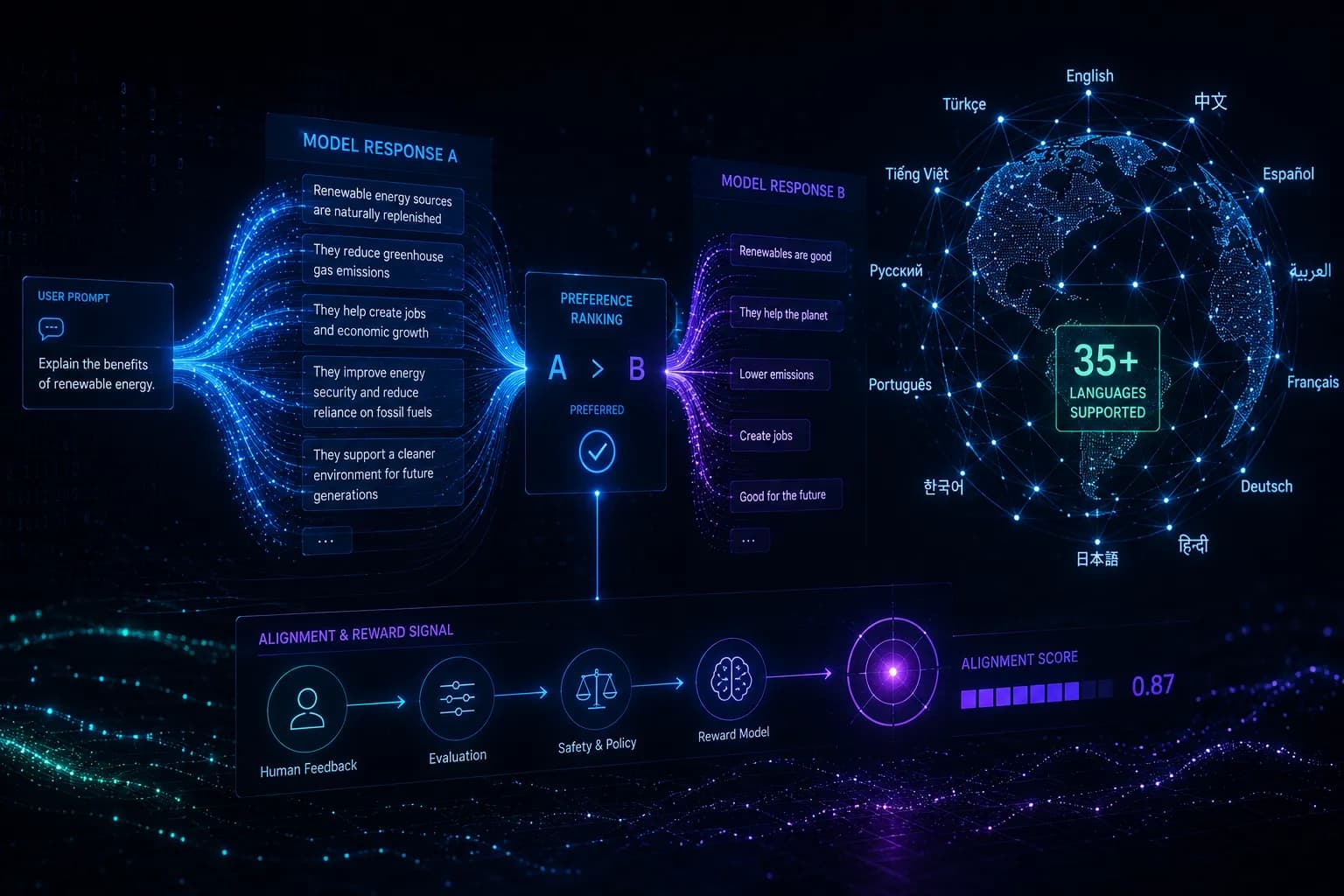
Where the data breaks down
- Preference and demonstration quality hinges on annotator judgment, which a crowd cannot hold consistent.
- Alignment has to hold across languages, not just English, or the model regresses outside its core locale.
- Frontier programs need a steady weekly cadence, which spot crowds cannot guarantee.
- Red-teaming needs skilled adversarial testers, not volume clickers.
How Corpshore AI delivers
- Employed, calibrated annotators produce preference and demonstration data against a shared rubric.
- Native, in-region annotators cover 35+ languages so alignment holds beyond English.
- A staffed pipeline delivers a plannable weekly cadence rather than variable crowd throughput.
- Skilled red-teamers probe for jailbreaks, unsafe outputs, and policy violations under a defined taxonomy.
From scope to delivery, in foundation models
Step through how a foundation models engagement runs under one operator and a single SLA.
1. Scope
We agree the rubric, task types, and language mix, and calibrate annotators against gold examples before the pipeline opens.
What we deliver
The operator advantage for foundation models
- Employed teams hold judgment consistent across weeks, which a marketplace crowd cannot.
- Native coverage in 35+ languages keeps alignment from regressing outside English.
- Annotation, RLHF, and red-teaming run under one SLA, so the alignment loop stays coherent.
Services behind this solution
Foundation models, answered
Ranked comparisons, preference pairs, SFT and instruction-following demonstrations, and reward-model training data. Work is done by employed, calibrated annotators against a shared rubric.
Ready to scope a pilot?
Tell us your modality, volume, and languages. We'll return an indicative scope, timeline, and cost band.