Computer Vision Training Data for Robotics: North America's 2026 Demand Surge
CVPR 2026 in Denver confirmed computer vision as the decisive capability gap in physical AI and robotics. This covers what US and Canadian teams need to build production-grade computer vision training data programs.
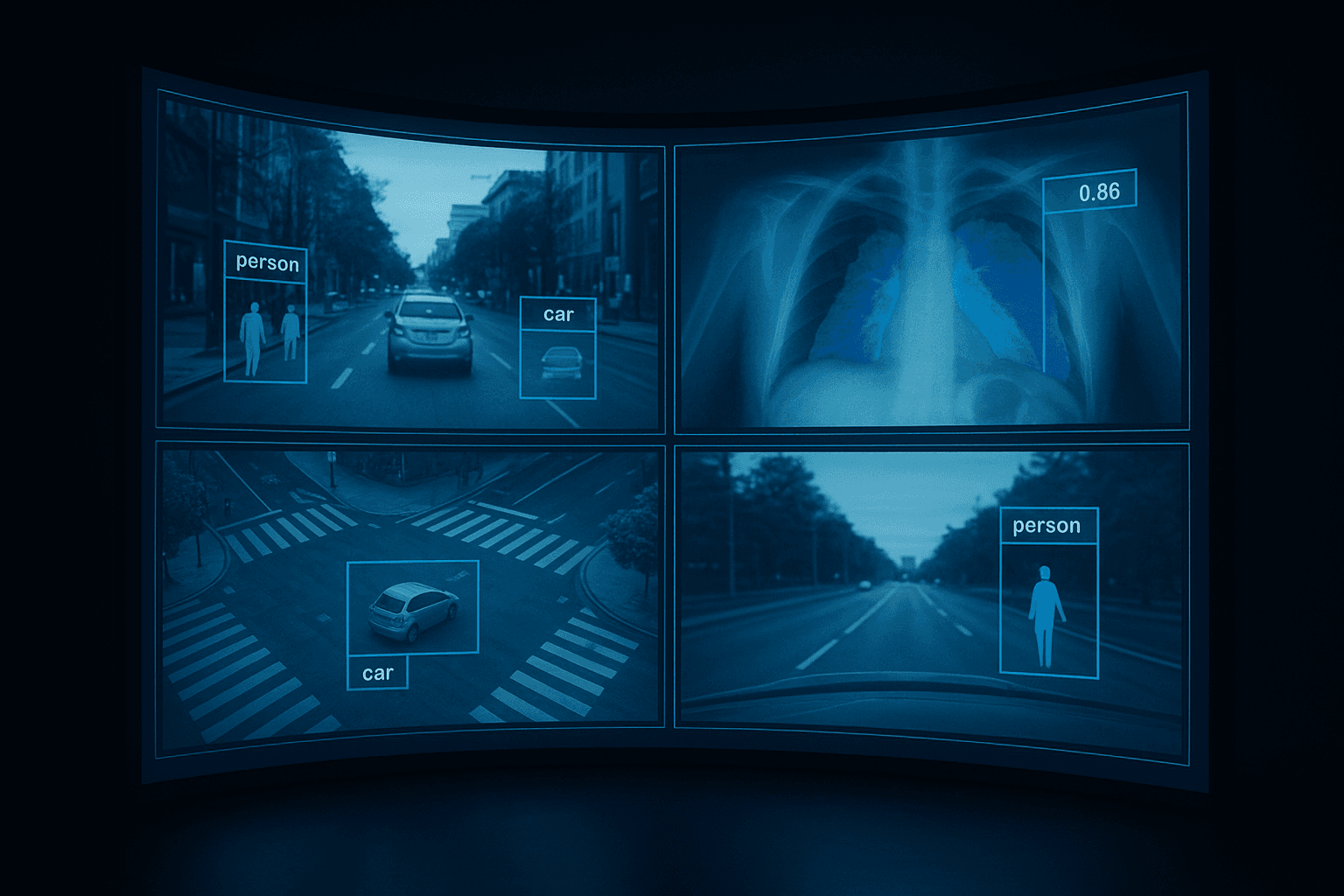
What CVPR 2026 Showed About the Robotics Data Problem
The Computer Vision and Pattern Recognition conference held at Denver's Colorado Convention Center in June 2026 featured Tesla, Waymo, and 40 other companies at the expo floor, with computer vision for physical AI systems dominating the applied research track. The defining theme was the gap between laboratory computer vision performance and real-world robot deployment: models that perform well in controlled settings fail on the visual ambiguity, occlusion, and lighting variation of real environments. The consistent answer from presenters was data: specifically, the need for larger, more diverse, and more precisely annotated training datasets.
RobotLAB's 2026 industry analysis named computer vision improvements as the most critical advancement needed for robotic scalability, arguing that vision capability determines which robots can operate outside controlled factory floors. This assessment aligns with the research track at CVPR 2026, where multiple accepted papers addressed zero-shot generalization failures in vision systems trained on insufficiently diverse data. The gap is well-characterized technically, but closing it requires annotation at scale.
The practical significance for North American AI teams is that robotics and autonomous systems companies, as well as enterprises deploying computer vision for quality inspection, inventory management, and worker safety, face a training data problem that cannot be solved with software tooling alone. The bottleneck is annotated image and video data: specifically, images and video captured in the conditions the deployed system will encounter, labeled with the precision the model requires.
Types of Computer Vision Data in Demand
Industrial inspection annotation is one of the highest-demand categories in North America in 2026. Manufacturing companies deploying vision-based quality control systems need annotated images of defect types, with bounding boxes, segmentation masks, and defect classification labels. The challenge is that defect annotation requires annotators with manufacturing domain knowledge who can distinguish between defect types that generalist labelers cannot reliably separate. This is a category where annotation quality directly determines whether a deployed inspection system is reliable.
Autonomous vehicle and autonomous mobile robot training data is a second major category. Lidar point cloud labeling, 3D bounding box annotation, and sensor fusion dataset labeling are specializations requiring technical annotator training. North American autonomous vehicle programs, including those at Ford, General Motors, and Waymo, as well as logistics automation companies, maintain large ongoing annotation programs to cover the environmental variation required for safe deployment. The scale of these programs, often 100,000 to 500,000 annotated frames per training cycle, requires outsourced annotation capacity.
Retail and commercial computer vision is a third growth area. Visual search, planogram compliance checking, and customer behavior analysis systems all require annotated image data. The Simbe Tally 4.0 retail robot, released in January 2026, uses shelf-scanning computer vision that requires annotated product images across thousands of SKUs. These programs are more accessible to mid-market companies than autonomous vehicle programs, with annotation requirements in the 10,000 to 50,000 image range for initial model training.
Annotation Specifications for Production-Grade Computer Vision
Image annotation for computer vision is not uniform. The annotation specification, covering the type of label, the precision required, the edge-case handling rules, and the inter-annotator agreement threshold, determines whether a labeled dataset will produce a deployable model. Teams that underspecify annotation requirements typically see models with strong average-case performance and poor edge-case performance, which is a critical failure mode for safety-relevant applications.
Polygon annotation for irregular object boundaries, semantic segmentation for pixel-level labeling, and keypoint annotation for pose estimation are more demanding than bounding box annotation in both annotator skill requirements and unit cost. For robotics applications requiring precise spatial understanding, bounding boxes are rarely sufficient. The specification decision has a direct multiplier effect on annotation cost: semantic segmentation typically costs three to five times more per image than a bounding box equivalent.
Quality assurance for computer vision annotation should include inter-annotator agreement metrics, edge-case review by domain-qualified supervisors, and systematic review of model failure cases traced back to annotation errors. Teams that skip the failure-case review cycle lose the signal that reveals whether annotation errors are driving model limitations, which is the most common root cause of computer vision model underperformance in production.
Building a Computer Vision Data Program in North America
Sourcing annotated computer vision data for a North American robotics or autonomous systems program involves four decisions: annotation type and specification, annotator qualification requirements, geographic and environmental coverage of source images, and quality assurance architecture. Each decision has cost and timeline implications. Getting the specification right before scaling annotation is the single highest-leverage decision in the program design.
Corpshore AI provides computer vision annotation services covering 2D and 3D bounding box labeling, semantic segmentation, keypoint annotation, and sensor fusion dataset annotation for automotive, robotics, industrial, and commercial applications. The Jwuma platform sources annotators with technical training matched to annotation complexity, with dedicated domain-qualified supervisors for industrial and medical imaging programs. For US and Canadian robotics and autonomous systems teams, Corpshore AI can ramp a production annotation program in 14 days with annotation specifications reviewed and agreed before the first batch. Contact Corpshore AI at corpshore.ai/start-a-pilot to request a computer vision annotation proposal.
Frequently asked questions
- What types of computer vision annotation are needed for robotics in 2026?
- Robotics programs in 2026 primarily need bounding box annotation, semantic segmentation, 3D bounding box and lidar point cloud labeling, and keypoint annotation for pose estimation. Industrial inspection systems additionally need defect classification labels. The specific type required depends on the robot's sensing modality and the precision required for the deployment environment.
- Why is computer vision identified as the key capability gap for robots in 2026?
- Computer vision determines whether a robot can accurately perceive and interpret its environment outside of controlled conditions. Robots trained on insufficiently diverse or poorly annotated image data fail to generalize to the lighting variation, occlusion, and object configuration they encounter in real deployments. CVPR 2026 research consistently pointed to training data diversity and annotation quality as the primary causes of this generalization gap.
- How much does computer vision annotation cost for a North American program?
- Annotation costs for computer vision vary widely by label type. Simple bounding box annotation starts at around $0.05 to $0.15 per image at scale. Semantic segmentation costs three to five times more per image, and sensor fusion annotation for autonomous vehicle programs is higher still due to technical complexity and annotator qualification requirements. Total program costs depend on scale, specification, and annotator tier.
- What is physical AI, and why does it require different training data?
- Physical AI refers to AI systems that interact with the physical world, including robots, autonomous vehicles, drones, and industrial automation systems. Physical AI requires training data collected in real physical environments, capturing the visual and sensor diversity of actual deployment conditions. This cannot be fully replaced by synthetic data, particularly for edge cases involving unusual environmental conditions or object configurations.
- How does Corpshore AI support computer vision annotation for autonomous systems?
- Corpshore AI provides specialized computer vision annotation for autonomous systems programs, covering 2D and 3D bounding boxes, semantic segmentation, lidar point cloud labeling, and sensor fusion datasets. Through the Jwuma platform, annotation teams include domain-trained specialists for automotive, industrial, and robotics applications, with quality assurance processes calibrated to production-grade annotation standards.
Published by
Corpshore AI
https://corpshore.ai