Human and AI Hybrid Annotation Workflows: The 2026 Market Standard
Hybrid annotation is the 2026 default for AI data outsourcing, market valued at $5.4 billion. What enterprise teams need to know before choosing a vendor.
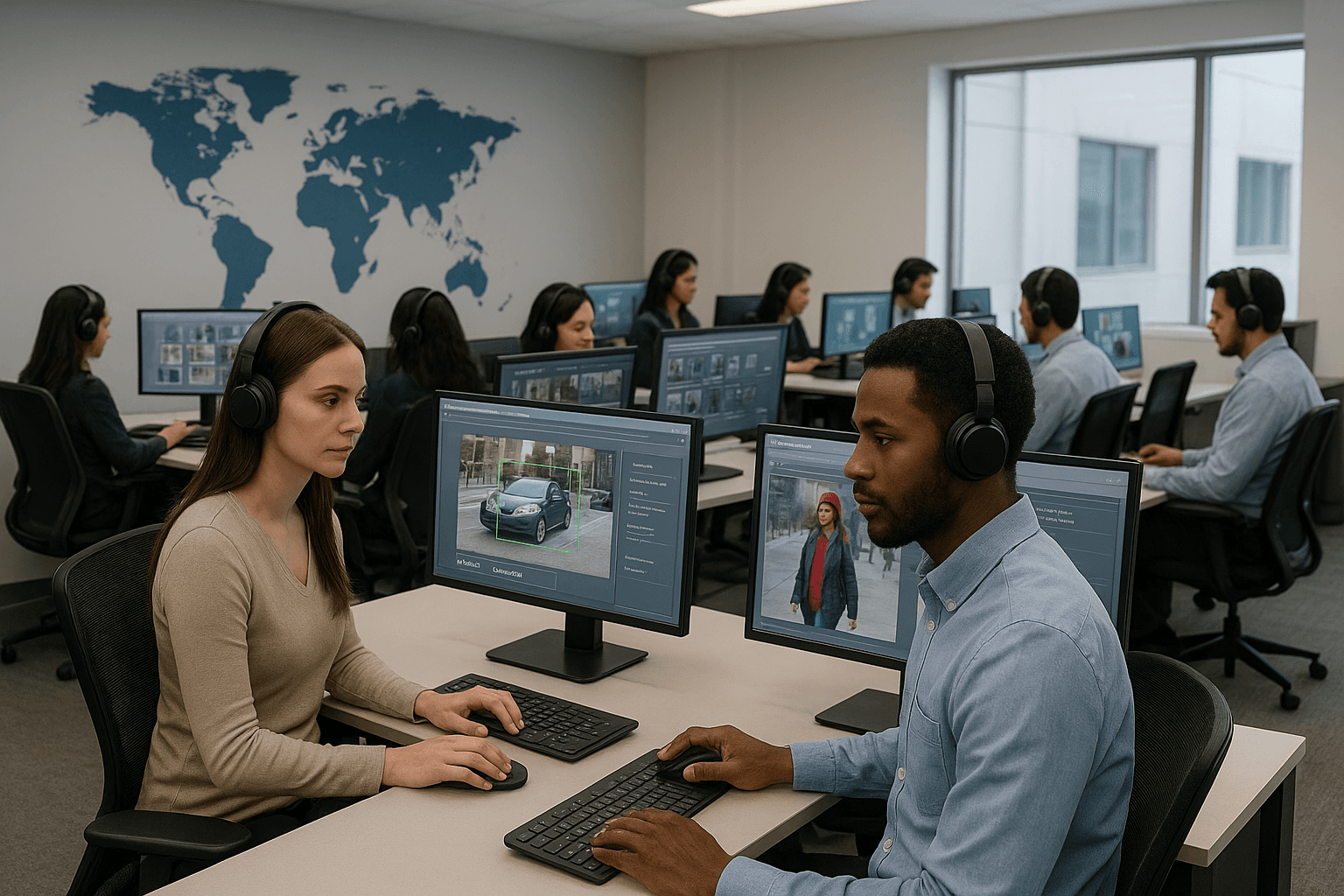
The Annotation Market in 2026: $5.4 Billion and a New Default Model
The global data annotation and labeling services market reached $5.4 billion in 2026, according to Stratistics MRC, with a projected compound annual growth rate of 26.8% through 2034 to reach $38 billion. This growth is driven by the expansion of enterprise AI programs requiring domain-specific training data, the shift from foundation model development at labs to production deployment at enterprises, and the rising complexity of annotation tasks as AI applications move from simple classification to agentic workflow evaluation.
The defining operational shift in 2026 is the emergence of hybrid annotation as the market standard. Hybrid annotation refers to workflows that combine AI-assisted pre-annotation, where a model generates candidate labels, with human review, correction, and validation. Conectys, an outsourcing analysis firm, described hybrid human and AI workflows as the default model for data annotation outsourcing in 2026, replacing pure manual annotation for most standard annotation task types.
The market is consolidating around vendors that can offer hybrid annotation at scale with appropriate quality controls. Pure manual annotation vendors without AI-assisted tooling face cost and throughput disadvantages compared to hybrid operators. Pure AI annotation without human validation faces accuracy and compliance risks that enterprise clients are increasingly unwilling to accept. The sustainable model combines both, with the balance between AI and human contribution adjusted to match the complexity and risk profile of each annotation task.
What Hybrid Annotation Actually Means in Practice
In a hybrid annotation workflow, the typical sequence is: an AI model generates an initial set of candidate labels for each item in the dataset, a human annotator reviews the candidate labels, makes corrections where the AI output is incorrect or ambiguous, and confirms or rejects the full label. The AI model is then updated using the corrected labels, improving its pre-annotation accuracy over time. This creates a compounding efficiency gain: as the AI model improves, human review time per item decreases.
The efficiency gain is real but bounded. For annotation tasks where the AI model performs well, the hybrid workflow can reduce human annotation time by 40-60% compared to fully manual labeling, maintaining accuracy at or above pure manual standards. For annotation tasks that require domain expertise, fine-grained judgment, or contextual reasoning that current AI models handle poorly, the efficiency gain is smaller and the human review contribution is proportionally larger.
Quality control in a hybrid workflow requires tracking both AI pre-annotation accuracy and human reviewer accuracy separately. A hybrid workflow where the AI model has high error rates and human reviewers are not correcting those errors produces lower-quality output than a pure manual workflow. Vendors claiming hybrid efficiency gains without publishing inter-annotator agreement rates or model accuracy metrics should be asked to provide those figures before contract award.
When AI-Assisted Annotation Works and When Human Expertise Is Irreplaceable
Hybrid annotation works well for high-volume, well-defined annotation tasks where the AI model can be trained on a representative sample of the target data. Standard bounding box annotation for common object categories, sentiment classification on customer feedback, intent detection in customer service transcripts, and optical character recognition on structured documents are all good candidates for hybrid annotation. These tasks have clear label definitions, large training corpora, and limited ambiguity that reduces the value of human judgment over AI prediction.
Human expertise is harder to replace in annotation tasks requiring cultural knowledge, ethical judgment, or domain expertise that is not well represented in AI training data. RLHF preference annotation, where annotators rank model outputs on dimensions like helpfulness, honesty, and harmlessness, requires human judgment about subjective quality dimensions that AI models cannot reliably self-assess. Medical imaging annotation, legal document classification, and cross-cultural content moderation require domain expertise that generalist annotation workers and current AI models both lack.
The practical implication for enterprise AI teams is that hybrid annotation is not a universal solution. Each annotation task type should be evaluated independently for its suitability for AI assistance. Tasks with clear label definitions and large training data availability benefit most from hybrid workflows. Tasks requiring expert judgment, cultural nuance, or ethical reasoning should use fully human annotation with strong qualification screening.
Evaluating a Hybrid Annotation Vendor: What to Actually Check
The key metrics for evaluating a hybrid annotation vendor are: pre-annotation model accuracy rate by task type, human reviewer accuracy rate on corrected items, inter-annotator agreement rate across the full dataset, error escalation protocols for cases where AI and human disagree, and data handling procedures for the AI model training data used in pre-annotation. The last item matters for enterprise programs where the annotation subject matter is proprietary: if the vendor's pre-annotation model is trained on client data without explicit consent, that creates IP and confidentiality risks.
Pricing transparency is a secondary but important factor. Hybrid annotation should be priced at a discount to pure manual annotation for the same task type, reflecting the AI efficiency contribution. Vendors that charge manual annotation rates for hybrid workflows are capturing the efficiency gain rather than passing it to the client. Detailed unit economics, broken down by AI-assisted items and human-only items, should be available from any reputable vendor.
Scalability and turnaround time are the final dimensions. Hybrid annotation vendors with established AI tooling can typically scale throughput faster than pure manual operations because the AI component does not have the same staffing constraints as human annotation teams. For programs with variable volume, hybrid vendors are generally more responsive to burst demand. Corpshore AI operates a hybrid annotation model across its standard annotation task types through the Jwuma platform, with AI-assisted pre-annotation and human quality review by domain-qualified annotators.
Corpshore AI's Hybrid Annotation Capability
Corpshore AI provides hybrid annotation services for enterprise AI teams across text, image, audio, and video annotation tasks. The Jwuma platform manages annotator sourcing, task assignment, AI pre-annotation tooling, human review workflows, and quality assurance reporting in a single managed program. For standard annotation task types, Corpshore AI's hybrid workflow delivers accuracy rates above 97% with throughput improvements of 35-50% compared to pure manual annotation at equivalent accuracy levels.
Enterprise AI teams sourcing hybrid annotation programs for the first time are encouraged to begin with a pilot batch covering a representative sample of their target dataset. A well-scoped pilot reveals annotation specification gaps, sets baseline accuracy expectations, and calibrates the balance between AI and human contribution before the full program is committed. Contact Corpshore AI at corpshore.ai/start-a-pilot to design a hybrid annotation pilot for your AI program.
Frequently asked questions
- What is hybrid annotation and how does it work?
- Hybrid annotation is a workflow that combines AI-assisted pre-annotation with human review, correction, and validation. An AI model generates candidate labels for each item in a dataset, then a human annotator reviews and corrects those labels. The AI model is updated with corrected labels over time, improving its pre-annotation accuracy and reducing human review time per item. Hybrid annotation is the default operating model across the data annotation outsourcing industry in 2026.
- How much does hybrid annotation cost compared to manual annotation?
- Hybrid annotation should cost less than pure manual annotation for the same task type, as the AI assistance reduces human labor per item. Typical cost reductions range from 25-50% depending on how well the AI model performs on the specific task. Vendors that do not offer a price discount for hybrid workflows relative to manual annotation are capturing the efficiency benefit rather than sharing it with clients. Always request a breakdown of AI-assisted versus human-only pricing.
- What annotation tasks should not use AI-assisted workflows?
- RLHF preference annotation, medical imaging annotation, legal document classification, and culturally sensitive content moderation are examples of tasks where human expertise is difficult to replace with AI assistance. These tasks require domain knowledge, ethical judgment, or cultural fluency that current AI models handle unreliably. Using AI-assisted pre-annotation for these tasks without expert human review increases the risk of systematic errors that corrupt model training.
- How large is the data annotation market in 2026?
- The global data annotation and labeling services market reached $5.4 billion in 2026 according to Stratistics MRC, with a 26.8% compound annual growth rate projected through 2034. Growth is driven by enterprise AI program expansion, rising annotation task complexity, and the shift from lab-based foundation model development to enterprise production deployment. The market includes both pure manual annotation and hybrid human-AI annotation services.
- What should enterprise AI teams ask annotation vendors about their hybrid workflows?
- Enterprise AI teams should ask annotation vendors to provide: pre-annotation model accuracy rates by task type, human reviewer accuracy rates on corrected items, inter-annotator agreement rates across datasets, error escalation procedures for AI-human disagreements, and data handling policies for the proprietary data used to train the pre-annotation model. These metrics distinguish vendors with well-managed hybrid programs from vendors using the term hybrid as a marketing label.
Published by
Corpshore AI
https://corpshore.ai